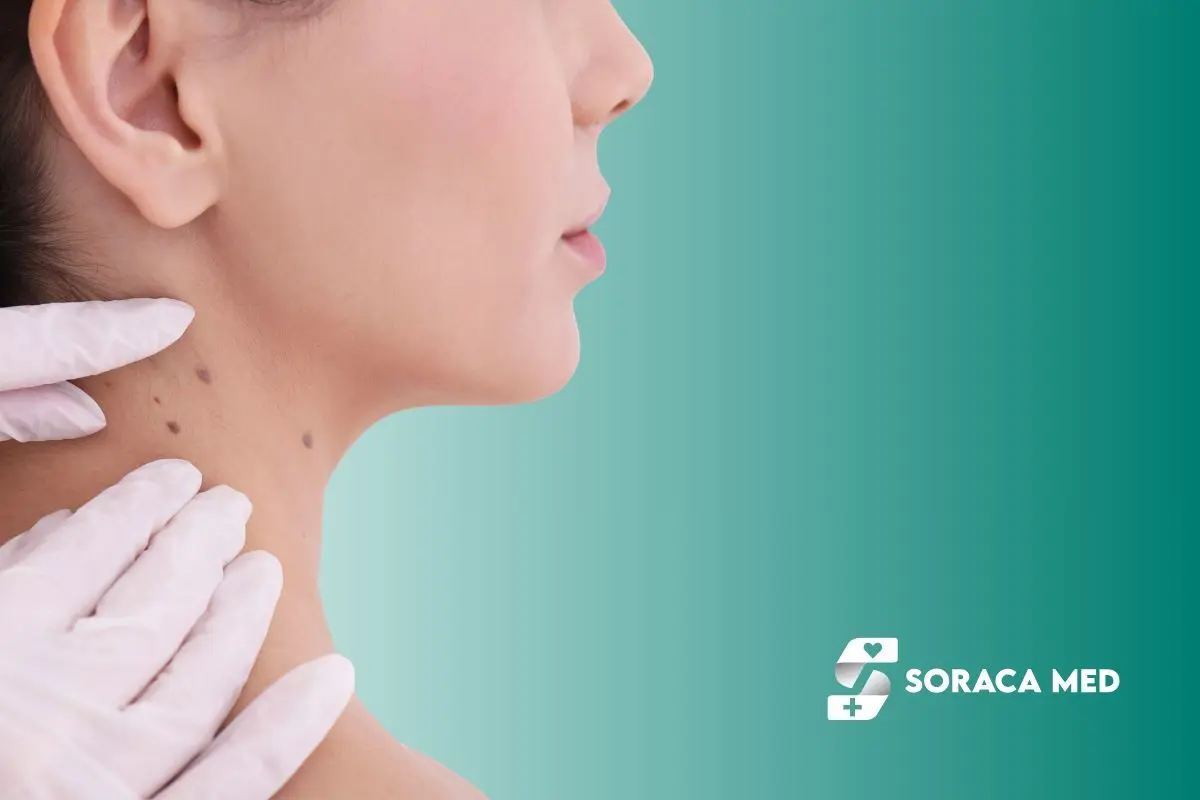
Mole removal in Antalya starts from €200 at Soraca Med. Most moles are harmless and are removed for cosmetic reasons or because they catch on clothing or jewellery. The most important rule comes first: any mole that is new, changing, irregular, itchy or bleeding should be examined by a doctor before removal, and a mole that could be suspicious should be removed surgically and sent to a laboratory, not destroyed with a laser. The right method depends on the mole: shave removal for raised moles, surgical excision for deeper or suspicious moles, and laser only for selected flat, clearly benign marks. This guide explains each method, the scar you can expect, aftercare and how to choose safely.
Mole Removal at a Glance
| Item | Typical detail |
| Reasons | Cosmetic, irritation, or medical concern |
| Methods | Shave removal, surgical excision with stitches, laser for selected benign lesions |
| Anesthesia | Local anesthesia |
| Procedure time | Usually 15 to 45 minutes per mole |
| Stitches | For excision; usually removed after 5 to 14 days depending on the area |
| Laboratory check | Recommended for any mole removed surgically, essential for suspicious moles |
| Starting price | From €200 at Soraca Med |
What Is Mole Removal and When Should You Consider It?
A mole is a cluster of pigment cells in the skin. People choose to remove moles because:
- They dislike how a mole looks, for example on the face
- A raised mole catches on clothes, a razor, a bra strap or jewellery
- A mole is in a place that is often irritated
- A doctor recommends removal because a mole looks unusual
The NHS advises seeing a doctor if a mole changes shape or looks uneven, changes colour or has more than two colours, starts itching, crusting, flaking or bleeding, gets larger or more raised, or if you notice a new mole. These can be signs of melanoma, a type of skin cancer.
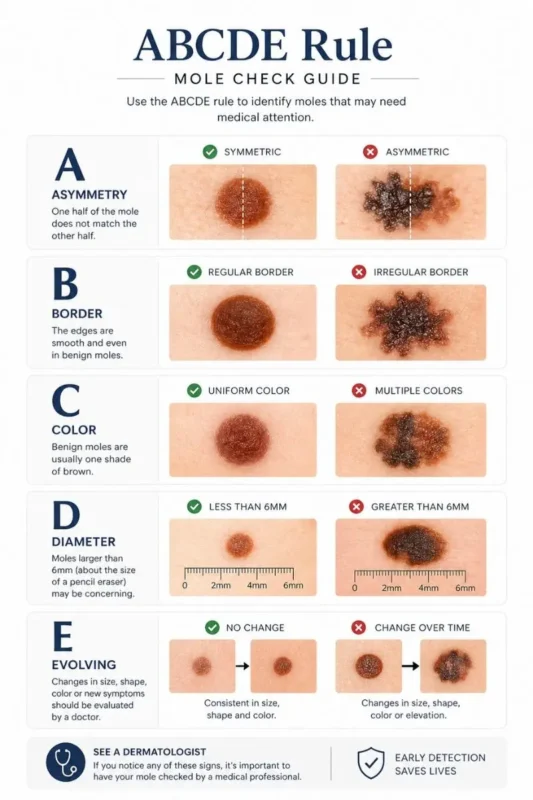
The ABCDE Check Before Any Removal
| Letter | What to look for |
| A, Asymmetry | The two halves of the mole look different |
| B, Border | Irregular, ragged or blurred edges |
| C, Colour | Several colours or uneven shades |
| D, Diameter | Larger than about 6 mm |
| E, Evolving | Changes in size, shape, colour or symptoms |
If a mole shows any of these features, it should be examined, often with a dermatoscope, before a decision about removal. Suspicious moles must be removed in a way that allows a full laboratory examination. Read more about skin cancer treatment.
Mole Removal Procedure Options: Laser vs Surgical Excision

| Method | How it works | Best for | Scar | Laboratory check |
| Shave removal | The raised part is shaved flat at skin level | Raised, benign-looking moles | Small flat mark, may be lighter or darker | Possible |
| Surgical excision | The whole mole is cut out and the skin is stitched | Deeper moles, suspicious moles, moles that regrew | Fine line, longer than the mole | Yes, complete |
| Punch excision | A small round blade removes the mole | Small moles | Small round scar, often one or two stitches | Yes |
| Laser removal | Laser energy breaks down pigment or tissue | Small, flat, clearly benign marks | Usually minimal | No, tissue is destroyed |
Laser is attractive because it leaves little mark, but it destroys the tissue, so the mole cannot be examined afterwards. For this reason laser should be used only after a doctor has confirmed the mole looks benign.
Cosmetic and Medical Benefits of Mole Removal
- Smoother skin and more even appearance
- No more catching or irritation from clothes or shaving
- Peace of mind when a mole is examined in the laboratory
- Early detection if a mole turns out to be abnormal
Does Mole Removal Leave a Scar?
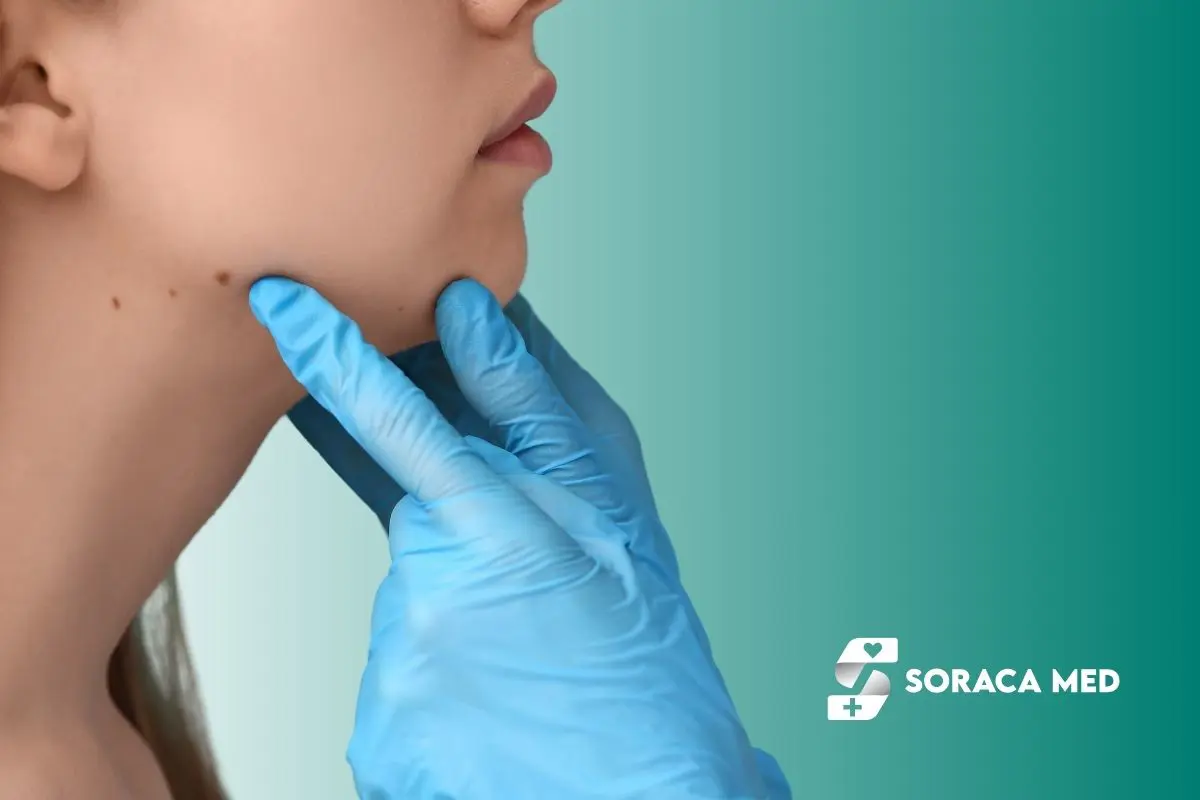
Every method that removes skin leaves some mark. The goal is the smallest, least noticeable scar. Shave removal leaves a flat mark that may be paler or darker than the surrounding skin. Surgical excision leaves a fine line, usually about two to three times the length of the mole, because the wound is closed in an ellipse to lie flat. On the face, fine stitches and placement along natural lines help scars fade. Scars usually look pink at first and fade over months. Keloid scars are more likely on the chest, shoulders and back and in people with a history of keloids.
Recovery After Mole Removal: Healing and Aftercare
| Time after removal | What to expect |
| Days 1 to 2 | Mild soreness; keep the dressing clean and dry |
| Days 3 to 7 | A scab forms after shave or laser removal; do not pick it |
| Days 5 to 14 | Stitches removed, depending on the area (face earlier, back later) |
| Weeks 2 to 6 | The mark fades from red to pink |
| Months 3 to 12 | The scar matures and becomes paler |
Aftercare tips:
- Keep the area clean and apply the recommended ointment
- Avoid stretching or heavy exercise that pulls on the wound, especially on the back
- Protect the area from the sun with clothing or sunscreen once healed, to reduce dark marks
- Use silicone gel on the scar if your doctor recommends it
Mole Removal Cost in Antalya Compared to the UK and Other Countries
| Location | Typical situation |
| UK | Cosmetic mole removal is not usually available on the NHS; private removal often costs several hundred pounds per mole |
| Western Europe | Usually similar to the UK |
| Antalya, Soraca Med | From €200, depending on size, number, method and laboratory examination |
The price depends on the number of moles, their size and location, the method and whether laboratory examination is included. You receive a written quote after the doctor has seen photos or examined the moles.
Mole Removal for International Patients: What to Expect
- Photos before travel: clear close-up photos of each mole with a ruler or coin for scale.
- Examination in Antalya: the doctor examines the moles and confirms the method.
- Removal: under local anesthesia, often the same day.
- Laboratory results: if a mole is sent for examination, the report usually takes several days to a few weeks and can be shared with you by email.
- Stitches: if your flight is before removal day, stitches can often be removed by a doctor at home.
Plan your trip so that you do not swim or sunbathe while the wounds heal.
Risks and Safety Considerations

- Infection or delayed healing
- Visible scar, raised scar or keloid
- Change in skin colour at the site
- A mole regrowing if pigment cells remain, more common after shave or laser removal
- Missing an abnormal mole if it is destroyed without laboratory examination
The most important safety step is to never remove a suspicious mole with a method that prevents laboratory examination.
Why Choose Soraca Med for Mole Removal in Antalya?
- A doctor examines each mole before choosing the method
- Surgical, shave and laser options, chosen for the mole rather than for speed
- Laboratory examination when indicated
- Fine stitching techniques for facial moles
- Prices from €200 confirmed in writing
For combined facial rejuvenation, see our pages on face lift surgery and neck lift.
Types of Moles and Skin Lesions
| Type | What it usually looks like | Notes |
| Common mole (naevus) | Small, round, evenly coloured, flat or raised | Most are harmless |
| Atypical mole | Larger, irregular shape or colour | Should be checked; may need removal for examination |
| Congenital mole | Present from birth, sometimes large | Larger ones need specialist follow-up |
| Seborrhoeic keratosis | Brown, waxy, “stuck-on” growth, common with age | Not a mole; harmless; easily removed |
| Skin tag | Soft, small flap of skin | Harmless; often in folds such as the neck or armpits |
| Dermatofibroma | Firm small bump, often on the legs | Harmless; removal leaves a scar |
A doctor can usually tell these apart with a dermatoscope. Anything uncertain should be removed in a way that allows laboratory examination.
Mole Removal on the Face
Facial moles need special care because scars are more visible. On the face, doctors often choose a shave removal for raised moles that look benign, or a fine surgical excision placed along natural lines for deeper moles. Stitches on the face are usually removed earlier, often after about five to seven days, to reduce marks. Sun protection afterwards is especially important on the face.
Myths and Facts About Mole Removal
| Myth | Fact |
| “Removing a mole can make it cancerous.” | Removal does not cause cancer. Examining a removed mole can detect problems early. |
| “Laser is always the best method.” | Laser destroys tissue, so it is only suitable for clearly benign marks. |
| “A removed mole never comes back.” | Moles can regrow if pigment cells remain, especially after shave or laser removal. |
| “Mole removal leaves no mark.” | Every method leaves some mark; the aim is the smallest, least visible scar. |
Preparing for Mole Removal
- Take clear photos of each mole beforehand, with a ruler for scale
- Tell the doctor about blood thinners and any history of keloid scars
- Avoid sunburn on the area before treatment
- Plan to keep the area clean and dry for a few days, and avoid swimming
Checking Your Skin at Home
Check your skin once a month, using a mirror or asking someone to check your back. Look for new moles and changes in existing moles, using the ABCDE guide. The NHS advises seeing a doctor if you notice a new mole or changes in size, shape or colour, or if a mole itches, crusts or bleeds.
Our Google Reviews
Our Bookimed Reviews
Frequently Asked Questions
How much does mole removal cost in Antalya?
At Soraca Med, mole removal starts from €200. The price depends on the number, size, method and whether laboratory examination is needed.
Is laser mole removal safe?
For small, flat moles that a doctor has confirmed look benign, yes. Laser should not be used on suspicious moles, because the tissue cannot be examined afterwards.
Will mole removal leave a scar?
Every method leaves some mark. Shave removal leaves a flat spot; surgical excision leaves a fine line that fades over months.
When should I worry about a mole?
See a doctor if a mole is new, changing in size, shape or colour, irregular, itchy, crusting or bleeding.
Can a removed mole grow back?
Sometimes, especially after shave or laser removal if pigment cells remain. Surgical excision has the lowest chance of regrowth.
Is mole removal painful?
It is done under local anesthesia. You feel the injection, and afterwards mild soreness for a day or two.
How long does healing take?
Usually one to two weeks for the wound, with the scar fading over several months.
Can I fly after mole removal?
Yes. Keep the wound clean and covered, and arrange stitch removal at home if needed.
Can a mole be removed for cosmetic reasons?
Yes, once a doctor has confirmed that it looks benign. Suspicious moles should be removed surgically and examined.
How long do stitches stay in after mole removal?
Usually about five to fourteen days, depending on the area. Face stitches are often removed earlier than back stitches.
Will a removed mole be tested for cancer?
Moles removed surgically can be sent to a laboratory. This is essential if a mole looks unusual.
How can I reduce the scar after mole removal?
Follow wound care advice, avoid stretching the area, use silicone gel if advised and protect the scar from the sun.
Sources and Medical Information
This guide is general patient information. The medical details are based on published patient guidance, including:
It does not replace a consultation: a doctor should examine any mole before removal, and their personal instructions always take priority. Prices are Soraca Med starting prices and are confirmed in your written quote. Last updated: October 2026.